
Common Questions
- Will the CPT steer my heavy displacement boat?
- Will the CPT steer my light displacement, high performance sailboat?
- Is it strong enough to steer my boat? (torque)
- How is the CPT different from other autopilots?
- Can Older CPTs be repaired and serviced?
- Is the CPT waterproof?
- My boat has hydraulic steering. Will the CPT work with hydraulic steering systems?
- Will the CPT work on a boat with a slanted wheel and geared steering system?
- Can the CPT be used on a boat steered by a tiller?
- Does the CPT connect to my GPS or navigation program?
- Does the CPT use a fluxgate compass?
Will the CPT steer my heavy displacement boat?
The CPT will generally steer heavy displacement boats from one to eight turns lock-to-lock. The CPT has a powerful motor and gearing, and uses the mechanical advantage of the steering wheel & steering system. When sailing you must be willing to trim and balance the vessel, as you would with a windvane, to reduce weather-helm. The most common vessels using the CPT are typically 30'-50' in length with 10-40,000 lb displacement. The CPT develops up to 86 ft-lbs of torque at the wheel which is enough to handle most wheel loads.
In winds or rough conditions the boat must be balanced to reduce weather helm. With too much weather helm the belt will eventually begin to jump in its cogs, an indication its time to reef and trim the boat. Many vessels have the CPT as well as a windvane. A self-steering back-up of some sort is recommended for long distance cruising.
The autopilot will turn the wheel at about 6 RPM under no load and can generate up to 86 ft-lbs of torque. As the load increases, the RPMs decrease. About 4.5 RPM at 30 ft-lbs, 3.7 RPM at 40 ft-lbs, down to 2 RPM at 60ft-lbs, etc.
At higher loads the belt may slip or jump teeth on the small drive pulley. This is normal and will not damage anything—it is caused by flexing of the bracket/mounting arrangement. The L-bracket is quite stiff and so this is less common with L-bracket mounting. This indicates a high load on the system and the belt jumping is just the weakest link. Increasing the belt tension will transfer these high loads to the shear pins and motor.
Another reason the belt can slip is if the ship’s rudder is being slammed by cross seas or following seas. Shock loads from the rudder can be transmitted to the wheel putting stress on the autopilot belt and shear pins. It is best to head off a bit in these conditions–the autopilot is not designed to handle these shock loads (shear pins will break). Choose a heading and adjust sails to give an easier/smoother ride.
The belts are generally long lived however they can break due to repeated shock loads transferred from the rudder. A belt tensioner is available which completely eliminates belt slip but reduces the life of the belt and shear pins.
Will the CPT steer my light displacement, high performance sailboat?
Yes, if you are willing to deal with the limitations of the pilot by reefing and balancing the vessel. The CPT’s compass is quick and responsive to heading changes, and uses very little electricity.
The manual controls set the pilot to one set of steering conditions; the vessel needs to be trimmed for consistent steering needs. With the vessel trimmed for directional stability the CPT performs extremely well. The CPT is not designed for steering needs that constantly change, such as needing the wheel quickly turned 90-degrees at the top or bottom of a wave and then smaller wheel corrections when surfing down the face of the wave. In large following seas the vessel speed and course must be adjusted for consistent steering needs.
A recent Islander 36 with fin keel and spade rudder reports great performance in the Pacific Northwest; downwind was no problem at all, he just needed to lower the rudder-control setting due to the increased downwind speed. A high performance Conser 47' catamaran crossing the Pacific has reported no problems in high winds, surfing down 15-20' breakers downwind at high speeds.
Is it strong enough to steer my boat? (torque)
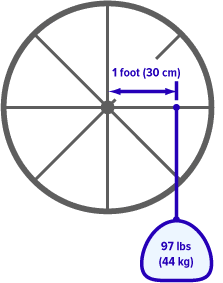
The CPT can produce up to 86 ft-lbs (116 Nm) of torque to your vessel's steering wheel. This would be the same force as hanging an 86 lb weight (or two 5-gallon water jugs) from one of your wheel's spokes one foot out from the center. Other wheel pilots may typically only produce 30Nm, or 22 ft-lbs of torque.
Torque is a force that rotates or turns things. You generate a torque any time you apply a force using a wrench or lever. Tightening a bolt with a wrench is a good example. When you use a wrench, you apply a force to the handle. The handle is a lever, and the force creates a torque on the bolt, which turns the bolt.
On your boat's wheel, torque is the amount of force it takes to rotate your steering wheel. Pushing down on one of the wheel spokes is the same as using a wrench or lever. The spoke is a lever, and the force on the spoke creates a torque on the wheel, which turns the wheel.
If you put 100 pounds of force (a 100 lb weight, for example) on your wheel spoke, one foot from the center, 100 ft-lbs of torque are generated. At a distance of two feet from the center, you only need 50 pounds of force to generate the same torque.
The autopilot will turn the wheel at about 6 RPM under no load. As the load increases, the RPMs decrease: about 4.5 RPM at 30 ft-lbs, 3.7 RPM at 40 ft-lbs, down to 2 RPM at 60ft-lbs, etc.
How is the CPT different from other autopilots?
The CPT is a rugged stand-alone autopilot that keeps a vessel on a magnetic compass course. With your boat on course, set the CPT and it will steer and keep your boat on that course, rain or shine. It is a course-keeping autopilot. For simplicity and reliability it does not have connections to rudder transducers, GPS, or other electronics. The CPT is designed for immersion and cockpit mounting, and is powerful enough to steer heavy displacement boats.
The teeth on the belt, wheel, and clutch eliminate slipping. The simple to use manual clutch engages the drive, and also provides emergency overload protection.
Please be aware that a magnetic compass course is not the same as a GPS course. In keeping to a good average compass course, your vessel will still be subject to drift from wind and currents. This is apparent when observing your GPS over time, and on a passage you will still need to navigate and make periodic adjustments.
Can Older CPTs be repaired and serviced?
We can repair and service newer CPTs and older CPTs that are still in good condition. Typical servicing involves replacing watertight seals & gaskets, and replacing relays after years of use.
See the repair and service guidelines for more information.
Is the CPT waterproof?
Cockpit autopilots are more exposed to the elements than their underdeck counterparts, so we have built the CPT for immersion.
The control box and drive box are designed and built to withstand immersion. We prefer to call the CPT truly water resistant, as the term “waterproof” is often misunderstood. Storing the unit improperly for long periods in standing water or flooded conditions can eventually exceed the rating of the watertight seals.
My boat has hydraulic steering. Will the CPT work with hydraulic steering systems?
Yes, the CPT works well with hydraulic systems, and routinely steer vessels over 40' with hydraulic steering. The CPT develops plenty of torque and rpm for hydraulic steering systems. Leaks and air in the lines must be removed for it to work well, and there should be minimal play in the linkage to the rudder. Any leaks or foaming in the system will cause play in the system which will impair the autopilot. The autopilot will turn the wheel at about 6.25rpm, no load. This is usually fast enough for helms with up to 7 or 8 turns lock-to-lock.
Will the CPT work on a boat with a slanted wheel and geared steering system?
Yes. Because the CPT utilizes a powerful motor and uses the mechanical advantage of the boat’s steering system, it can steer boats with steering systems from two to eight turns lock to lock. It will work with worm geared or rack & pinion steering systems as long as they are working properly—no loose linkages, etc. On slanted wheels, the CPT drive box is usually mounted on the sole or sidewall by using an optional L-bracket.
Can the CPT be used on a boat steered by a tiller?
No, not at this time.
Does the CPT connect to my GPS or navigation program?
No. The CPT is a dependable but stand-alone autopilot that will maintain your vessel on a compass course. One benefit of this simplicity is that there are no external connections to fail.
Does the CPT use a fluxgate compass?
The CPT uses an electronic heading sensor which uses gyro, acceleration and magnetic sensors to determine the compass heading.
Go to the top of this page